













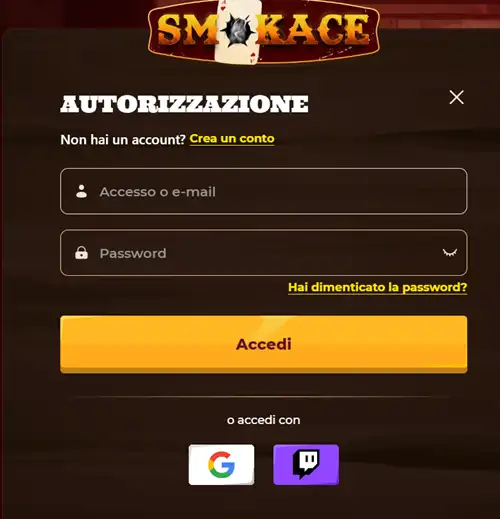
Smokace Sign Up Italy

In 2026, Smokace in Italy is evaluated based on access, account, payments, mobile gaming, and control tools for adults.

Fortune Gems 2 Slot

Table of Contents

  • The Dog House Megaways Slot
  • Lucky Joker 10 Extra Gifts Slot
  • Sword of Ares Slot
  • Floating Dragon Hold & Spin Slot
  • Leprechaun Riches Slot
  • Fruit Cocktail Slot
  • The Dog House Megaways Slot
  • Sword of Ares Slot
  • Fruit Million Slot
  • The Dog House Megaways Slot
  • Big Fisherman Slot
  • Big Fisherman Slot
  • Seven Books Unlimited Slot
  • Smokace Fortune Slot
  • Sword of Ares Slot
  • Floating Dragon Hold & Spin Slot
  • 9 Mad Hats Slot
  • Floating Dragon Hold & Spin Slot
  • Big Bass Splash Slot
Login 1

After Smokace Login: What to Look For

The first login isn't just about getting in. It's about understanding if the account makes clear sense. A platform available in Italy for adult users, in compliance with applicable rules, should allow you to find your balance, personal area, history, payments, and break tools within minutes. If these sections are readable, the session starts well. If, on the other hand, each item requires attempts, the effort comes even before the game.

Imagine you have twenty minutes of free time in the evening. You open your account and want to immediately understand if you can use it calmly. At that moment, you don't need noisy graphics or a generic promise. You need a simple structure: a clear profile, easy-to-read movements, settings that don't seem hidden, and a path that doesn't force you to guess every step.

Many users make the most common mistake right here: they log in, open a random game, and only afterward try to figure out where the important functions are. It's better to do the opposite. First the profile, then notifications, then history, then control settings. Only then does it make sense to decide whether to start a session.

Smokace Sign Up And Data To Prepare

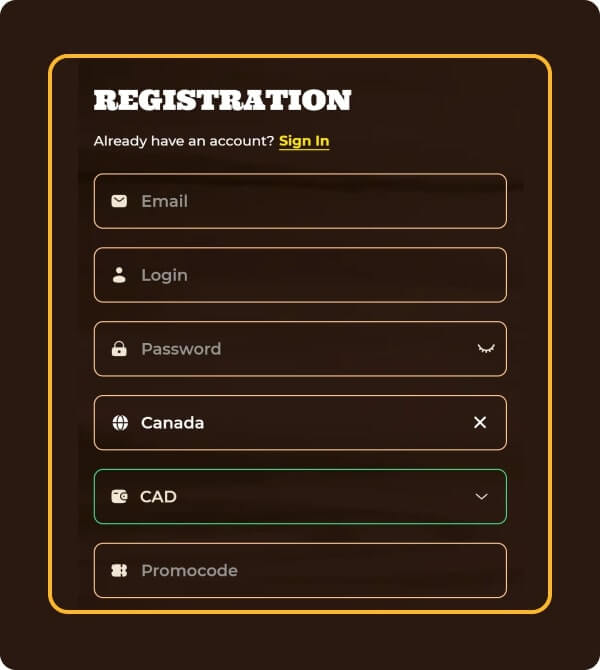
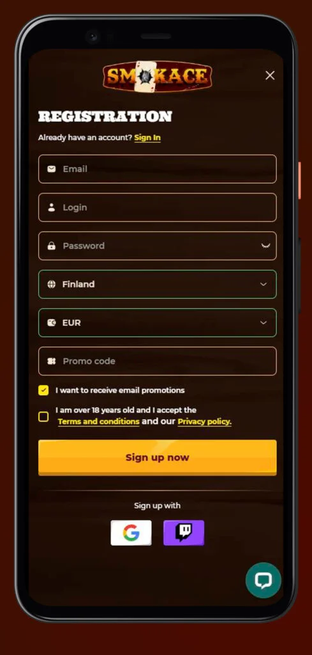
Registration should be brief, but not hasty. Name, contact details, date of birth, credentials, and initial preferences must be consistent from the start. Truly annoying errors rarely arise from complex steps. They arise from details left out due to haste: a poorly written email, a number no longer in use, a password saved without attention.

Imagine filling everything out on your phone while also responding to other messages. This is the typical scenario where you leave a field unchecked or save unclear credentials. Nothing happens at the moment. Then, a subsequent check is enough to understand how much those rushed details weigh.
The First Ten Minutes In The Profile

After registration, the most useful choice is not to jump straight into the catalog. It's advisable to first go to the personal area and understand where documents, history, notifications, balance, and support are located. This small routine lightens all subsequent sessions because it avoids starting from scratch every time you log in.

Login 2

Imagine registering in the evening and wanting to log back in the next morning in seconds. If you've already seen where recent transactions are and how to access settings, your account follows you. If, however, you leave everything pending, even a simple verification or balance check can feel longer than necessary.

Verification, Contact Details & Password

Profile verification shouldn't be tackled at the last minute. It's better to gather documents when you're relaxed, with good lighting and enough time to check that everything is legible. Imagine having to fix a file while you're out, with little patience and attention. This is the situation where the most avoidable errors are made. Keeping contact details updated and strong credentials are part of the same logic: simplifying what comes next.

When Access Gets Blocked

An interrupted login doesn't necessarily mean there's a serious problem. Sometimes it's just a half-completed confirmation, a credential typed in haste, or a security step that requires more attention. The worst thing is to repeat the same action five times in a row without looking at what's really happening.

Imagine trying to log back in from your phone while walking or talking to someone. A minimal distraction is enough to miss a notification or mistype a detail. The most organized users do one simple thing: they stop, reread the on-screen message, check the details, and try again only after understanding where the flow was interrupted.

Login 3

Payments & Transaction Order

Payments are where theory ends. Until that moment, everything can seem simple: clear menus, readable catalog, organized profile. But when you need to deposit, check your balance, or request a withdrawal, the quality of the experience becomes concrete. That's when you understand if the account was set up well or if there are still pending details.

The most useful rule is also the most underestimated: stop thirty seconds before confirming any operation. Amount, method, profile status, and the real reason for the transaction. Four quick checks. It seems like little, but almost everyone skips them when the decision is driven by haste or the desire to change the session's tone with an impulsive gesture.

Imagine a slightly confused late evening. You still have your phone in hand and think about making another transaction to continue a bit longer. In that case, the problem isn't technical. It's the moment you're deciding. Stopping for half a minute changes much more than it seems.

Area To Check

What to Check

Why It Is Useful

Profile

dati coerenti e recapiti attivi

evita correzioni all'ultimo minuto

Chosen Method

intestazione e disponibilità reale

riduce tentativi inutili

History

ultimo movimento registrato

chiarisce lo stato del conto

Documents

file leggibili e completi

facilita i controlli necessari

Personal limits

soglie di spesa e pause

mantiene ordine nella sessione

Mobile Use & Account Continuity

In 2026, many users open their accounts more often from their phone than from a computer. Therefore, it's not enough for the platform to be available on mobile. It must be truly convenient in the contexts where the phone is used: short breaks, waiting times, commutes, evenings on the sofa, quick checks before leaving. In those moments, quality is measured by readability, speed, and clarity of the main functions.

Imagine you have ten clear minutes while waiting for someone. You want to see your balance, recent transactions, notifications, and figure out if you really have time for a session. If a few taps are enough to get oriented, the mobile experience works. If, on the other hand, each area requires unnecessary steps, the phone stops being helpful and becomes a source of distraction.

Continuity with the computer also matters. Not everything needs to be identical, but the account should maintain the same logic. Balance, profile, history, support, and payments should be in easily recognizable areas in both cases. Otherwise, the user feels like they are using two separate environments.

More organized users enter from their phone with a specific purpose, not out of habit. They check their account, decide, act, and then leave. This small difference changes a lot. Mobile is convenient precisely because it shortens time, but if a clear objective is missing, convenience easily turns into distraction.

Short Sessions And Quick Checks

When you have little time, it's best to use the account like a dashboard, not a showcase. First balance, then notifications, then history, then decision. Imagine opening the platform during a ten-minute break. If you already know what to check, the time is enough. If, instead, you start tapping screens without order, ten minutes easily become thirty, and the account stops seeming linear.

Games, Budget, And Real-Time

A platform isn't just evaluated by access and payments. It's also evaluated by how it accommodates the pace of the session. Some people log in for ten minutes, some have an hour free, some just want to check their account, and others seek a more defined gaming moment. These situations require different approaches. When the account doesn't help distinguish them, the user tends to do everything at once and lose track.

Imagine two opposite scenarios. In the first, you're tired, short on time, and want a light session. In the second, you have more time and want to better follow what you're doing. If you use the platform the same way in both cases, the problem isn't the catalog. It's the absence of a clear framework. More experienced users quickly learn to decide the available time first and only then the type of experience.

The budget should also be considered very early in the choice, not halfway through the session. Separating a precise amount from other expenses and linking it to a time limit makes everything more readable. It seems like a basic rule, but it's precisely the one that prevents the session from extending on its own.

Knowing when to quit is as important as knowing how to start. Many only think about the entry point. Almost no one seriously considers the exit point. Yet, an organized session almost always ends at the predetermined time, not when fatigue or nervousness have already taken over from choices.

How to Stop Before Pushing It

The signal isn't always financial. Sometimes it comes earlier, in the form of haste, irritation, or the desire to recover immediately. Imagine telling yourself "just a moment longer" several times within the same fifteen minutes. That's already a clue. At that point, a short break or a complete closure is worth more than another attempt made out of nervousness.

Limits, Breaks, And Temporary Self-Exclusion

Self-control tools should be considered a normal part of the experience, not a last resort. Spending limits, short breaks, and temporary suspensions help prevent a session from losing its structure. Imagine a stressful week where you notice yourself opening the account more out of reflex than choice. In that case, a clearly set break is worth more than any promise you make to yourself at the end of the evening. It helps create distance between impulse and action, not complicate your relationship with the account.

Support, Assistance, And Final Evaluation

Support seems secondary until you really need it. Then, when a transaction isn't clear or an access is interrupted, it becomes a central part of the experience. Therefore, it's wise to identify it early and understand how to contact it effectively. The most useful message isn't the longest. It's the most precise.

Imagine writing only "it doesn't work." You'll probably have to explain everything from scratch. If, instead, you indicate the device, time, area involved, and the message seen, the conversation starts much more concretely. More practical users gather the facts first and then ask for help. It's a simple habit, but it saves a lot of time.

The final evaluation of Smokace, for an adult user in Italy in 2026, should stem from a very concrete chain: access, registration, profile order, mobile quality, payment clarity, pause tools, and assistance. If this chain holds up in real situations – a short break, an evening session, a history check, the need to stop – then the overall judgment grows for solid reasons and not out of momentary enthusiasm.

FAQ

The most useful thing is not to jump straight into the game. It's better to first check your profile, balance, history, notifications, and control tools. This brief initial tour helps you understand if the account is truly readable. If you do this on your first access, all subsequent sessions become more linear and less improvised.

It's best to have a legible document, an active contact method, strong credentials, and a clear idea of your personal budget ready. Complex steps aren't necessary, but a minimum of organization is. Those who prepare these elements in advance almost always avoid unnecessary delays during their first day of use.

The phone is very useful for quick checks, notifications, balance, and small operational steps, especially when you have little time. It works well if you log in with a specific purpose. If, however, you open the account out of habit or boredom, you risk making more taps than necessary and losing the thread of the session.

The signal usually comes when you are no longer choosing with clarity. You keep entering and exiting the same areas, want to recover immediately, or extend the session beyond what you had decided. At that point, a short break can help much more than another attempt made out of inertia.

Because it's not just for seeing amounts and times. It's for reconstructing how you actually used the account, at what pace, and in what order. For those who log in from mobile multiple times a week, this tool helps distinguish a series of short sessions from orderly and conscious use.

The best way is to be brief but precise. You need to indicate what you were doing, on which device, in which area of the account, at what time, and with what message appeared on the screen. This makes the request much more useful and reduces lost steps. A generic message, on the other hand, often forces you to start over.

Before you start, it's worth asking yourself two simple questions: how much time do I really have, and how much do I want to spend today? If the answers are clear, the session starts off better. Those who enter without these guidelines often end up opening too many screens, changing direction multiple times, and losing track within the first few minutes.